Matt D. Smith wrote recently that AI is faster at design than he is. At producing, he is right, and the same is true for me. An agent will produce a working page while I am still deciding how I feel about the headline. I have stopped pretending otherwise, and I have stopped wanting to compete on that axis at all.
Drawing was never the slow part of my work. Deciding was.
What the speed actually gives you
Fast output, with the same problems every time. Spacing that almost works. Text that did not need to exist. Eyebrow labels everywhere, each one saying nothing. No real hierarchy, so your eye does not know where to land.
So my process with AI is mostly removal. I take what it gives me and cut until everything left has a vital reason to be there. The eyebrow test: what is this saying? Is it strengthening the message or adding one more blah? If the heading already does that job, the eyebrow goes. Then I step back and ask the older questions: what am I saying, to whom, and why. A voice shows up in your eye as colour, size, position, and ratio to its neighbors. When those are right, the work starts sounding like someone.
How I actually work now
I run design, code, video, ads and SEO as one system, with agents inside it. Fewer tools, fitted to how I work instead of the other way around.
A real week looks like this. I designed the direction of my new studio site myself: the layout, the type, the feel. Then I built it with an agent. It wrote pages and copy with me, and I corrected both until they sounded like me. It ran a measured performance pass that took the lab Lighthouse score on mobile from 86 to 100 and brought the largest paint from 4.1 seconds down to 0.9. On phones the site shows a still of the animated background instead of the animation, because that is the right call, not the easy one.
The studio site on desktop.
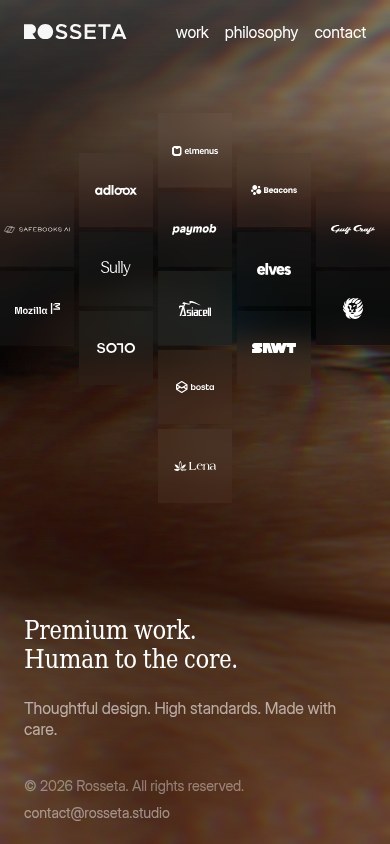
The same site on a phone, which shows a still instead of the animation.
The hover states on that site open into real project artwork. I chose the direction, approved what made the cut, and the agent wired it in, checked the live pixels, and when the framing clipped the work, it fixed the framing. Direct, generate, inspect, correct. That loop is the job now.
Direct
Generate
Inspect
Correct
Generated work is a draft, not a delivery. Sometimes the idea is right and the execution is wrong, and I would rather redraw it myself than ship something almost right. Almost is where generic work lives.
This is also why I am building the studio to be agent-native. Not because agents are magic, but because a small team with agents can carry several projects at once, if judgment stays in one place and context is written down where agents can find it. The writing-down is the unglamorous part. It is also what makes the speed usable.
What I am still figuring out
Coherence. Repeating the system on a new project without rebuilding it from zero every time. It is an improvement loop that does not end, and I do not think it is supposed to. But I am seeing results, and the distance between having an idea and holding it in my hands keeps shrinking.
Where I land
There is AI in the work. The human is at the core. That line sits at the top of my studio site, and it describes how the work actually gets done. When everything can be generated, choosing is the craft. Speed is only useful if you know what to keep.
FAQ
Is AI faster than designers?
At producing options, yes, by a distance. At knowing which option deserves to exist, no. That part is still a person's job, and it is the part clients actually pay for.
Should designers learn to work with AI agents?
Yes, but as a craft, not a trick. Learn to direct, inspect and edit at speed. Generating is cheap. Knowing what to keep is the skill.
What stays human in an AI-assisted process?
Judgment, taste and context. The machine knows what things usually look like. It does not know what you are trying to say, to whom, or why it matters.
What does an AI-assisted design workflow look like?
Direct, generate, inspect, correct. I set the direction, the agent produces, I check the live result, and I correct what is almost right instead of shipping it. Most of the work is removal.